Showing posts with label history. Show all posts

Monday, 19 September 2022

State Funeral


I thought I would be more emotional during the Queen’s funeral. I was up at 2:00 a.m. to catch the start of the proceedings – mostly people arriving at the Abbey ahead of the service – and hung in there until 6:00 a.m., when the Queen’s motorcade crept out of London en route to Windsor. The procession from Westminster to Wellington Arch was gruelling – and I wasn’t even following on foot! Given the time between the funeral and the committal service, I figured I could grab a nap and be awake for the final stages at St George’s Chapel.

Nope. I slept past it; again, thank the gods for Youtube.

Ten days is a long time. At this point, I was more aggrieved for the royal family, especially the King and his siblings, for having to march in line behind the coffin once more. Of course it’s to honour their mother as much as the late monarch and I would have wanted to do the same, but oh, my, the miles they have trudged in Her Majesty’s wake. And, I dare say, at their ages. I can only imagine their relief that all is finally over. Closure has occurred, the second Elizabethan Era is ended and a new reign begins.

Shouldn’t something have changed? The world feels the same. The sun rose this morning, autumn is still scheduled for the end of this week, the war is still on in Ukraine. I imagined that her death would somehow mirror my own mother’s passing, when my surroundings took on a stunning new brilliance I hadn’t seen before. The royal Elizabeth was as important as mine, yet despite ten days of mourning, with four spent lying-in-state, now that it’s done, it’s done. There might be some global follow up in the next couple of days, but guaranteed the focus outside the UK will soon enough revert to the usual business of “suffering and greed, here today, forgot tomorrow”.

As for me, it’s back to walking my own path, being the best I can be in any given moment – but remembering Her Majesty’s example, which was really not dissimilar to what my mother taught me about treating others with kindness and respect. I’m grateful to have witnessed these massive moments in history. I have been touched through the connection that binds me to every living soul, uniting us in grief and sympathy for the loss of an exceptional person. Perhaps I can’t foresee a difference to my life in the aftermath ... yet there will be unexpected moments when I am reminded of the change in this country’s hierarchy. It may be a tiny thing, like a filing a chargeback from the King’s Printer when a month ago I was filing them from the Queen’s Printer, or something more poignant, like watching the King’s Christmas message when it used to be given by the Queen, but I will have those moments and then I’ll know.

Actually, I kind of know already. When someone passes on, whether famous or family, everything changes. We just don’t always recognize it.

With love,

Sunday, 11 September 2022

God Save the King


I wonder how strange it must feel for the former Prince of Wales to sign himself “Charles R”.

Though it’s only been a few days since the Queen’s passing, the adjustment to having a King has been easier than I’d originally imagined, perhaps because yesterday was about the proclamation and accession of the new monarch rather than about Her late Majesty. The formal proceedings at St James’ Palace were fascinating to watch. I never thought I’d say this, but bless Youtube as a repository for such things. At the end of a busy day prepping for my return to work, Ter and I were able to catch up on this piece of living history hours after it had happened. Time zone issues, you know.

Maybe it’s as much because she and I are career public servants as we are Royalists that we observed with keen interest the reading, signing, and witnessing of the accession proclamation by the King and Privy Council members. Draft Orders-in-Council were approved regarding use of the existing royal seals pending creation and authorization of new ones, one of a million changes to be made when a king succeeds a queen. Even here in Canada, in BC, there are protocols regarding the Queen’s portrait (drape it in black), the state of legislation passed under the previous reign (they remain in effect), and the shift of lawyers named from Queen’s Council to King’s Council (it’s automatic and immediate).

Again, His Majesty gave a fine speech, this time to the assembly. There is no doubt he gets both the gravity of his new responsibilities and the weighty challenge of following his mother’s stellar example. I still think he’ll do well enough in his own right, in his own way.

I was particularly touched – and amused – when the motorcade departing Buckingham Palace at the end of the day yesterday suddenly stopped halfway along the Mall. The Rolls carrying the King veered off at an angle and came to a full halt. The back door opened and His newly proclaimed Majesty got out for a spontaneous walkabout with spectators along the road. The scramble of media cameras to seek and focus on him with the crowd was hilarious, as the car had stopped between established view points and no one was prepared for it. Yet it confirmed for me the suspicion that his private grief may be helped by sharing in the public’s, for the Queen was a beloved figure in many people’s lives as well as within her own family.

There’s the surreal thing again. In absorbing the protocols around naming a new sovereign, I am reminded that the sole reason for them is that Queen Elizabeth has died. The reminder came this morning, when I awoke to the news that her coffin had arrived at Holyrood House in Edinburgh, there to await tomorrow’s service at St Giles ahead of transport to London and a lying in state at Westminster until the funeral on the 19th. Charles is in a uniquely painful position, taking on his mother’s job while simultaneously mourning her loss. Surely no other member of his family can relate so acutely to the awful contradiction of ascending monarch with mourning son. On all counts, I truly wish His Majesty well.

God save the King.

Saturday, 17 July 2021

Buckle Up


Last week my chiropractor asked me if I was planning any trips to Vancouver now that BC is thisssss close to achieving herd immunity. I said no way; even before COVID, I was done with Vancouver. These days, I think Victoria is too crowded! Besides, as I get older, the hassle of travel outweighs the benefits of being there.

The doctor didn’t disagree—but he’s also booked a golfing trip to Arizona next March. He’ll get there in three days, driving a “doable” (so he says) 900 kms a day, and will enjoy the trip more on the road than being squished into a fully loaded airplane for a few hours.

“Hey,” I said brightly, “in two or three years, if you’ve got two hundred thousand dollars, you can book a seat on Virgin Galactic’s sub-orbital flight from YVR to Phoenix and get there before you leave!”

He paused in rearranging my vertebrae. “What’s that?”

I explained about the FAA approving Richard Branson’s company to begin commercial operations in the next few years. “They flew the prototype last weekend,” I said. “Now they just have to build the actual space plane.”

My chiro was amazed, not just about the concept, but that I actually knew about it.

To be fair, I only know about it because Ter was already glued to CNN when I got up last Sunday morning. The test flight was airborne—with Sir Richard aboard—and I missed the part when they reached zero gravity, but at least I was able to watch the landing in real time. I love flying and I love going fast and I love aerodynamically designed anything, so I felt the rush of history being made when the plane landed safely.

Pretty darned cool, before you start thinking about it. I mean, billionaires floating around in the stratosphere for fun seems like a gargantuan waste of money, possibly environmentally irresponsible, and yet another example of the increasing disparity between the rich and the rest of us. At least Branson isn’t reserving seats solely for those who have more money than sense. He’s partnered with a non-profit to cover the cost for some ordinary people to take a trip beneath the stars. So there’s hope for some little kids who dream of getting there but who could never afford it on their own.

I say “beneath the stars” because it seems the intention here is to establish a sub-orbital commuting service, albeit a hella expensive one, rather than visiting space itself. One small step for a billionaire philanthropist may actually be one giant leap for inter-continental travel. So, if I had the cash, would I sign up for this once-in-a-lifetime über-experience?

No, thanks. Despite the thrill of travelling faster than the speed of sound, I doubt my body would respond well to zero gravity. Though I wonder what kind of in-flight snacks would be offered ...

Oh, I know! Fast food!

Thursday, 1 July 2021

Oh No, Canada


Today may be Canada’s birthday, but the territory existed long before France (at the time) gave the colony a name. It probably already had a name, I just don’t know what it was. The boundaries were different, too, as determined by the Indigenous peoples who lived here long before the Europeans’ arrival changed everything for them.

Don’t get me wrong. I love living here. I’m grateful to live here. It’s the best country in the world, but it didn’t start out that way and we have a long way to go before descendants of the original inhabitants have any reason to believe it.

At the end of May 2021, the bodies of 215 children were discovered buried on the property of a residential school in Kamloops. Just a few weeks later, another mass grave was discovered in Saskatchewan. I can’t go into it more deeply than that, as I am not qualified to comment. I’m grateful to be here, but my being here is predicated on a colonial government’s shameful attempts to destroy an entire culture first by appropriating their land, then by taking (and killing) their children.

I am not an activist. I don’t march in protests. I haven’t even paid that much attention to media stories about native blockades and whaling rights and so on, but when I learned (too recently) about the residential schools and the Sixties’ Scoop, a small part of me died. On hearing about those buried children, I wept.

Out of respect for grieving First Nations, this year the City of Victoria cancelled plans for a virtual Canada Day celebration. In consultation, however, local Indigenous leaders felt it would be wrong to dismiss the occasion entirely, so it’s become a learning opportunity for those of us who need educating.

Like me.

The truth must be told. History must be embraced, not erased, if we wish for true reconciliation with Canada’s Indigenous peoples. I sense no desire in them for punishment or vengeance. It seems all they ask is that we listen to them with respect and recognize them as the original stewards of this magical land. Reconciliation is key. We can’t undo what was done, but we can certainly right the wrongs of the past by changing our ways now and moving into Canada’s future together.

Maybe then, we will truly have something to celebrate.

Sunday, 27 June 2021

Listen Up


Wednesday, June 30, 2021, has been proclaimed A Day to Listen. On this day, no matter what their regular format, radio stations across Canada are committed to broadcast stories of courage and survival from our Indigenous peoples. It’s time. We need to hear about their experience as much as they need to tell us about it, for only through sharing the burden of truth can we progress together in healing and reconciliation.

In the era of music streaming and custom playlists, this is where radio proves it’s still relevant. Having worked in the industry for a short time back when, I understand how multiple stations are able to broadcast content simultaneously—assuming that’s what they mean to do. Could be that local stations will air local stories, though it seems less likely given the quick turnaround time from proclamation to air date. I rather suspect the content will be housed in a mothership location and accessed through the miracle of modern technology ... much more modern than the tech I worked with in the early 1990s!

Gone are the days when the DJ had any control over what got played. The music is still a factor, but now it’s part of a formula aimed at a particular demographic to attract the most advertisers. I wonder how Wednesday will play out, sponsor-wise. I’d hesitate to sell commercial time on such a day, as goofball ads for hot tubs or pizza parlours would clash like mad with the serious intent of the programming.

What’s important is that we tune in on the 30th, at least for part of the day. Listen to some of the stories and learn something we didn’t know before, that might help us to understand more about what really happened in our shadowed past so we can build a brighter future. I’m all for it. I’ll be listening.

Will you?

Perfectly Imperfect


Last week I learned that “baroque” stems from the Portugese word meaning “imperfect pearl”. In the show I was watching, the pristine sphere of a cultivated pearl was displayed alongside a spludge of matching iridescence but woefully irregular shape.

If you think about it, life is very much like a baroque pearl. We’re oysters struggling to produce a flawless result. We strive for perfection in everything, yet achieve it in almost nothing.

Does that negate the struggle? Is an imperfect pearl less valuable than a perfect one? And, should it be? The oyster who produces an imperfect specimen is just as stressed as the oyster next door, who may actually be more stressed by the pressure to get it right the first time. Besides, as much beauty exists in imperfection as in the opposite—and sometimes you needn’t look that hard to find it.

Perfect pearls exist under false pretences, by the way. They’re like F***book lives, cleverly manipulated to look like naturally occurring phenomena.

The only perfect thing in this universe is, well, the Universe. Of course, there are moments of perfection in life, but they are moments. Transient, impermanent. Which is, I believe, what makes them perfect. Life itself is meant to be imperfect. It’s the only way we can learn anything! It’s also the reason why we’re here. There are two potential outcomes to anything we try: success or a lesson to be learned. No failures. Just learning.

I don’t know where we got the idea that everything we do, say, display, create or achieve must be perfect. Maybe it’s a holdover from where our spirits originate. We remember what it is to know perfection, ergo we knock ourselves out trying to recreate it in this dimension. A noble notion, yet the cause of so much misery at the same time. After all, who among us is perfect?

In truth, we’re all baroque.

With love,

Saturday, 26 September 2020

Words, Words, Words


My parents always had a stack of books on the hob. One of my earliest birthday presents (my fifth or sixth, I think) was a hard cover book, the first in a series aimed at kids that I collected avidly over the next few years. School libraries kept me entertained with the “Henry and Beezus” novels by Beverly Cleary and horse stories galore by Marguerite Henry and Walter Farley. I was so obsessed with horses, in fact, that my first crack at writing a novel myself (at age twelve) was about a girl and a wild horse. Not surprisingly, it was never finished.

I read a bunch of other things at the same time – “Rosemary’s Baby” and “The Exorcist” spring to mind (where were Mum and Dad??) – then I tripped into my teens and discovered historical fiction. As my genre identity developed, bodice rippers shared shelf space with classic tales of kings and queens. A copy of Kathleen Winsor’s “Forever Amber” yet resides in my home library, along with Jean Plaidy’s Charles II trilogy and Dorothy Dunnett’s six-volume “Lymond Chronicle”. Lymond in particular was a coup for sixteen-year-old me, given the thickness of each volume and the tiny print on every page. But, man, it was a compelling ride from my perennial place on the sofa. It’s definitely a repeat read.

Reading it then probably saved my sanity in the daily struggle with my bones.

Sometimes I overreached. As a teenager in the 1970s, I wasn’t sophisticated enough to know that an author named Taylor Caldwell was actually a woman, but because “The Arm and the Darkness” had musketeers on the cover, I bought it in paperback and sat down to read.

I started but didn’t finish it. I’m not sure why; I think the subject was heavier than expected for the space I was in at the time. When I evolved to where I might have been able to sift the story from the excessive wordage, my focus had shifted from swashbucklers to night crawlers thanks to my older sister’s copy of “Interview with the Vampire”. From there, science fiction and fantasy pretty well owned me, though I maintain a deep and abiding love for the seventeenth century.

Yep, I’ve read a lot of books in my life. Lately, though, I’ve made a conscious effort to try new things, and I have discovered jewels in Indigenous and mainstream literature. Conversely, I’m equally inclined to revisit old favourites. Amazon may be an evil entity trying to swallow the world, but it’s also provided a means by which I can explore other worlds without leaving the house. In a COVID environment, it’s a handy tool. Handier still is the Kindle that allows me to read in bed without concussing myself when the book falls forward. Anyway, one night while pondering where to search next, I wondered if Taylor Caldwell was still in print. I remembered the book I couldn’t finish and wondered if I could grasp the story now. I did the search, and darned if “The Arm and the Darkness” isn’t available in a Kindle edition.

So I bought it. Downloaded it. Whatever.

It’s still a wordy read. It’s written in the style of the old masters—Dumas and Cervantes and their contemporaries—so I have to wade through a ton of narrative to find the plot itself, but at least I’m old enough to understand what’s happening and why. A lot of it escaped me the first time. Truth, the style is too cumbersome, though I see now how it might have influenced my own tendency to overwrite—a tendency, might I add, that I’ve tried to change over the years. I also must have read more of it than I thought the first time; a lot of it is familiar though the nuances are definitely easier to espy. I have just reached the point where memory fails and am moving into deeper water. The adventure I had anticipated as a teenager appears to be more of a cerebral treatise on religion and the social hierarchy—but I am finally old enough to get the point.

Took me a while, eh?

Sunday, 12 November 2017

A Patch of Poppies


I was in a bit of a quandary about Remembrance Day this year. Too many newscasts fraught with gun violence and acts of terrorism, and civil wars in places we don’t hear about because there’s no business interest for the West – I’ve been pretty cynical of late, so the timing wasn’t great for November 11. It seemed to me that the sacrifices made, the lives lost and families destroyed during, well, every darned war we’ve seen since The Great One and The One to Stop All Others, have all been for naught. Pointless. A truly senseless waste because, looking at where we are now, it solved nothing. The world is still in conflicted turmoil with no apparent end in sight.

Toss my deity, Sting, into the mix. For months, I’ve been looping Children’s Crusade, one of my favourite songs from his first solo album. I don’t think he’s that wild about it, but I love it despite – or perhaps because of –  its tragic theme. Poppies are prominent throughout, starting with the boys who perished in the first World War, through to 1980s London, where the next generation have become what he poetically called “opium slaves”. It’s hardly his fault that I happened on a rogue patch of poppies and the phrase “poppies for young men” immediately came to mind. I thought, Brilliant – a theme for my Remembrance Day blog post! Only in the months between then and now, I lost my perspective.

Duelling dictators, ongoing problems in the Middle East, the Russians (another subject on Sting’s first album that remains annoyingly relevant), religious wars, civil wars, nuclear wars ... the list goes on and on, ad nauseum. By this time last week, I was nothing more than resigned to go through the motions. I mean, you have to wear a poppy, right? Otherwise, you’re being disrespectful. But inside, I viewed the poppy as a symbol of a failed exercise.

When Ter and I talked about Remembrance Day, I ’fessed up with my mixed feelings. She did not disagree. She even sympathized, as I had a point about how messed up the world remains despite the staggering loss of life in those two wars. A few hours later, after she’d pondered the predicament, she was able to adjust my perspective by reminding me of context.

“Don’t look at the world right now,” she said. “You have to remember that the threat back then was present moment. If those sacrifices had not been made, our parents’ lives would have been vastly different and so would ours. In that respect, what they gave was supremely profound and made a definite difference at the time. And at the time is what matters.”

She was right, of course. Then, as if to prove her point, I saw news interviews with a couple of the few surviving veterans who fought in WWII. They each told a story of imminent threat, of an enemy so powerful that neither thought anything of signing up to stop it. They were not fighting against future dictators or nuclear nutballs or religious extremists. They were fighting to save their Now.

The same might be said of every war that’s ever been fought; after all, the beast was not invented in 1914. It seems there’s always a threat. So long as we believe that war is the way to peace, my little patch of poppies is a blood-coloured point on a long and grisly timeline. However, I want to end this post on a positive note, so here goes:

Remembrance Day will outlast the soldiers who survived those battles. Veterans of more recent conflicts will take their places rather than stand beside them at the ceremonies in successive years. So they should. No one who goes to war should be forgotten or ignored; they deserve our respect and our gratitude. The world has become a more perilous place, yet there are still men and women brave enough to stand in defence of human rights and freedom. If one day a year is all they ask of me in return, I can give this much.

I can wear a poppy and I can mean it.

Sunday, 15 October 2017

If It Ain’t Baroque ...


Whenever I see the title of JS Bach’s “Air on the G String”, all I can think is how chilly it must feel.

If the radio is set to a baroque station, I know that Ter has been ironing. This cracks me up because ... actually, I’m not sure why it’s so funny, but her choice of laundry music does make me smile.

This is how seriously I perceive the music of my favourite century. Despite my fondness for the 1600s, it seems I don’t much care for the tuneage of the time. I don’t mind it, of course, but I won’t play it myself unless I’m writing a piece relevant to the period. Strangely enough, the soundtrack for “Versailles” isn’t reflective of the century, either. It smacks more of present day Ibiza than baroque Europe (though I’d probably get the CD anyway, even if it was crammed with Bach, Handel and a Hallelujah Host of Others).

Baroque music makes for good ambient noise, however. One of my cultured co-workers (she plays both classical guitar and Celtic harp—the talent pool at work is proof that there’s no money to be made in the arts) has a radio in her cubicle. Wedged between offices as she is, and placed on a high traffic corner, she finds it easier to concentrate on her job if Seattle’s National Public Radio is playing in the background. On a crazy day in any workweek, I’ll speed from my office, where the playlist ranges from classic Motown to cool jazz to 70s rock, and be rushing to the copy room when the lilting strains of a baroque violin will stop me in my tracks. Sometimes, I’ll even drop into my co-worker’s guest chair. When she looks inquiringly at me, I’ll say, “Just taking a civility break.”

Such music may be that which was claimed to soothe the savage breast. It certainly calms me in the midst of a hectic workday. It inspires images of perfectly aligned gardens, fashionable ladies and stylish gentlemen, all well-mannered and treating each other so cordially that it’s almost offensive. Better times and better men, yes?

Heck, no. The French Revolution might not have happened had the aristocracy been as elegant and ordered as the music of the day. Perhaps it’s merely an example of paradox sprung from a composer’s will to hide the truth of society at the time. Art these days is a more accurate reflection of where we’re at—a film parade of serial killers, political extremists, spies, renegades in fast cars, and superheroes sworn to save us from annihilating ourselves; music from angry children grown into angry adults, and underage girls shaking their collective booty as if a show of skin is empowering. Culture these days isn’t terribly cultured at all. Between the honesty in present day art and the hypocrisy in baroque composition, that civility break looks pretty darned good.

Sunday, 31 January 2016

Suffragette City


January 28 was the centennial anniversary of women winning the right to vote. It was also the thirtieth anniversary of the Challenger explosion—an event I remember because it happened during my lifetime. I’ve always had the right to vote; the fight for it happened long before I was born … yet not so long ago. One hundred years isn’t that many in the big picture.

Women’s issues continue to be issues, however. With the US presidential election looming, the argument for/against is once again in contention for candidate support on either side.

A female president would be pretty cool. I admire Hillary Clinton. She’s made her way in a man’s world, and she’d probably be a good president, though I think her focus might be more on foreign policy given her portfolio as Secretary of State during the Obama administration. Looking good to the rest of the world while your home is in a shambles seems to occupy most political leaders’ minds, male or female. Besides, I’ve watched enough women in power to know that many of them don’t care about their struggling sisters, and if they do stand up on the issues, they’re not taken seriously by their male counterparts.

Maybe a woman isn’t the best advocate for pay equity, health care and education. Maybe it should be a man who sees those points for what they really are: issues that affect not just women, but everyone on the planet.

If I was entitled to vote in the US election (thankfully, I’m not), I’d vote for Vermont governor Bernie Sanders (D). I’ve heard him speak on a few occasions, and he’s a guy who gets it. He speaks eloquently and passionately about the problems close to home, those issues almost universally dismissed as “women’s issues”: child poverty, poor education, inaccessible health care and, from there, planned parenthood. He recognizes that these resolving these issues is important to the nation as a whole. They are not unique to women. They are society’s issues, but if we insist on labelling everything, perhaps they should be termed “children’s issues” because—let’s face it—the future lies with the little ones.

Just a thought.

Sunday, 30 November 2014

Scotland the Brave?


November 30 is St Andrew’s Day. My office calendar, rather than a Scot, told me; St. Andrew being the patron saint of Scotland, like St. George watches over England and St. Patrick is claimed by the Irish. The three crosses combined make a pretty nifty British flag … but did the Scots and Irish actually want to be part of the United Kingdom? I don’t think so …

Ter and I have been watching Neil Oliver’s History of Scotland, a ten-part series that traces the land of my ancestors from its beginnings under the Picts to the twenty-first century. From the first episode, a particular theme is prevalent: Scots are a difficult people to conquer. The Vikings tried. The Romans tried. The English tried from the day the Romans quit, employing everything from trickery to brute force and failing on all counts. The countries were united by an irony when Elizabeth Tudor died without issue and her Scottish cousin’s son inherited the English throne. The country England wanted to rule now ruled England, so the tables turned and they got cranky over how many Scots had influence in the English court. I can’t blame James VI/I, either. The Scottish nobles hadn’t been that generous with him, but neither had the English. According to Oliver, he had a greater vision for the kingdom, but the only folk who want change are the ones who have something to gain from it so he didn’t have a lot of support from his English lords. They did, however, succeed in Anglicizing the royal Stuarts to the point where Charles I was neither fish nor macfowl and my sweetheart, Charles II, was so thoroughly scunnered by the overzealous Covenanters during his exile that he visited Edinburgh but once—and reluctantly—after his Restoration.

Something else has occurred to me as the series progresses: historically, England has needed Scotland more than Scotland needed England and I suspect the same holds true today. Witness the frantic pandering committed by the British PM ahead of the recent referendum on should Scotland reclaim her independence. The fearmongering worked, but only by a small margin. The doomsday downers were prophesying economic disaster if she broke from the UK. Really? For which side? Economic disaster happens every day; it’s been a given since economics took over the world. Instability inevitably accompanies change, but eventually, all settles down and we move on. Seems to me that Scotland has always been a republic by nature—the crowning of kings served to (sort of) unite the clans under one banner against the English pig dogs, but none save the kings themselves believed they were divine. The country is rich with natural resources; it’s stunningly beautiful in the wildest ways, the people are clever and inventive; heck, the Scottish royal court was more cultured than the English in the time of Henry VIII. His sister’s marriage to James IV was sought to strengthen the Tudors, not the other way round. So somewhere along the line, Scotland began to believe that she couldn’t survive without the English.

I think she can. So do 44.7% of her resident population—and, surprisingly, my father, who has never given me much indication that he favoured one route over the other. The ex-pat was so disappointed by the outcome of the referendum that he dared to put it in writing and has permitted me to post it here. If you ever wondered where I got my gift, here’s your first hint. Enjoy.

* * *

So, now it is over and Scotland is no more.
Unwilling to take a chance on its own prowess and skills but willing to cling to England’s apronstrings and risk that the pre-vote promises will be kept by what the French once called, “Perfidious Albion.”
 It is, I think worth quoting from a well-known source of information the derivation of that phrase as follows:

“Diplomatic sleights, duplicity, treachery and infidelity with respect to promises made or alliances formed with other nations, by the government of England in their pursuit of self-interest.”

It is now, unfortunately too late to say, “Scotland beware.” You believed the crocodile tears, shameful hypocrisies and fearful prophesies of mass unemployment and rising prices made by past masters of duplicity and now must remain with bowed head and bent knee, begging for scraps which may or may not be cast disdainfully from the Westminster table.
In 1305, William Wallace died in agony … and it now appears in vain, at the hands of the English. Perhaps the first verse of a Scottish rallying cry should be re-written, thus:

“Scots wa’ hey wi’ Wallace bled,
Scots wham Bruce has often led,
Ye hiv made yer gory bed,
Noo, lie in it....an’ dee.”

I will now remove the Scottish emblem from my car.  It might leave a dirty scar, but that is only fitting, considering the circumstances.

* * *
I love you, Daddy.

Tuesday, 11 November 2014

Lest We Forget


You can only remember if you survived it. In the comfort and safety of your untroubled life, you can merely imagine.

Imagine, then, those who went before, who went bravely and naïvely into battle, face to face with the enemy (boys like themselves), armed with bayonets and met by machine guns. Imagine those who were wreathed in poisoned gas, blinded by smoke and mustard fumes, their throats too choked to scream, heroes robbed of wits and possessed by a terror unseen in your wildest nightmares.

Imagine those who perished in open fields, in wooded copses and muddy trenches. Imagine those who died far from home, who left their mothers and sisters and sweethearts on a mission to retrieve the Kaiser’s helmet and were never seen again.

If ye break faith with us who die
We shall not sleep …

In Flanders Field was written by a man, a witness to the slaughter of a generation sent forth to preserve the liberty of others. In the poem, the dead pass us the torch and warn us against breaking their faith—but can ceasing to fight be considered a break of their faith? They know now, knew as soon as they shed their broken and bloody flesh, that war is not the way to peace. We remember them today because they offered their innocence, their futures, and their very lives to ensure that the world was a safe place for everyone to live.

That it is worse now than it was then, is an insult to their sacrifice.

So remember why they went forth so courageously, in pursuit of an ideal that lies within reach of every living soul yet remains untouched. Remember that war is the worst horror we can visit upon ourselves and do everything in your power to Stop It.

Perhaps then, the dead will sleep.

Monday, 11 November 2013

Poppies


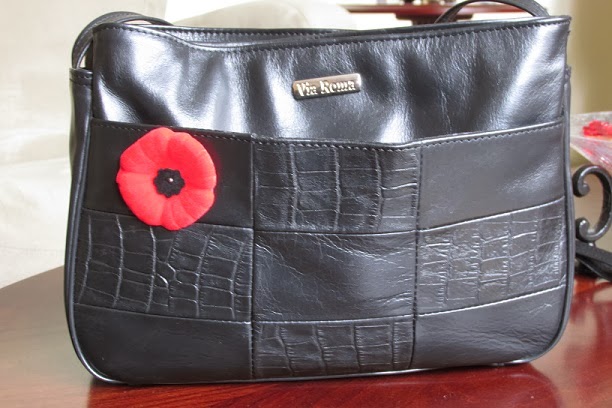
I wear my poppy on my purse. I don’t think it’s disrespectful; no one has said to me, “Hey, lady, it goes on your lapel!” I change up my coats at this time of year, and while I could have bought a poppy for each one, I’ve only just thought of it so will change my practice in 2014. In the meantime, I’ve had the one with me everywhere I go. 

This far into the 21st century, when there can’t be more than a handful of veterans left who fought in World War I and the number of those who survived the Second is dwindling daily, it’s hard to imagine how horrible war really is. I mean, was. If it was still as horrible as it was during the World Wars, maybe it wouldn’t be happening anymore. Problem is, war has become so sanitized, so easy and impersonal, that we don’t even think about it except to shake our heads and say how awful it is. 

How do we know? We’re safe and secure (relatively) in our padded little corner of the world. War has been happening pretty much through the length of my life. I’m just not affected by it because the battles are fought elsewhere. Sure, Canadian troops are deployed to those places, but I’m not from a military family and the country itself is only under siege from foreign investors. In no way do I mean to belittle the sacrifice of service to one’s nation. I believe in peace. I’m just unsure that war is the way to achieve it. 

So when Remembrance Day comes along, I am reminded of those who serve and have served. We think primarily of the World War vets because the historic value in those conflicts is immense – even though we’ve learned nothing from them except how to make it more comfortable for those indirectly involved. Conflict continues in other parts of the world and young men (and women) continue to endanger themselves for the combined cause of peace and freedom. We have veterans from the Gulf and Afghanistan wars, which got press but were buried amongst other news items so it was hard to pay real attention unless you knew or were related to someone who was actually there. Or worse, who was killed in action. I don’t know why people sign up. I wish there was no such thing as a call to arms. If we could solve our own problems without conflict and bloodshed – and interfering in others – maybe November 11 would become a celebration of peace rather than a requiem for those who died fighting for it. 

I accidentally stabbed my finger on the pin of my poppy the other day. I was about to make a big drama of it until I remembered why I have a poppy in the first place. 

Lest we forget.


Sunday, 21 July 2013

100 Years B.P.


The Big Pink 2013

The house where we live is known as The Big Pink. It was built in 1913. Yesterday, the strata threw it a birthday party to which we – the Lone Renters – were invited, along with numerous friends of our four neighbours, and as many previous owners/tenants as the search crew could find.

It was a gas.

We didn’t stay long, however. The annual Moss Street Paint-In happened yesterday as well, and as it’s a perennial must-do event, we took a couple of hours to stroll up and down the street that practically backs onto the Pink property, checking out the artists and the crowds and the market at the corner, all in pristine sunshine and a festive state of Now.


Then we dropped into the party. The planning committee had researched the house’s history through the City Archives, and posted around the yard were pictures of the Pink and its neighbours as newly-constructed buildings, bits and blurbs of the City of Victoria throughout the last century, and we saw our own names added to the tenants’ list dating back to the 1920s and 30s.

Four suites for 80-plus years and five since the penthouse was put on in the late 1990s. All were rental units until 1995, when it was converted to condos – this loved and lovely old house has weathered a hundred west coast winters and the combined energy of its occupants over a full century.

If the Big Pink could talk, what would she say?

Be welcome. Be safe. Be at peace.

That’s what I felt on my first visit in July 2012. It turns out that the current residents are all kind and generous people and I have grown very fond of them, but back then, there was only the house to make an impression. After 100 years of sheltering souls, the Pink was willing to embrace and shelter Ter and me (and we were badly wounded, but that’s another story).

If any ghosts live here, they are contented ones. It’s not a tormented, haunted house. It’s not a sick and neglected house. It’s not even the oldest house we’ve called home – but it is easily the most benevolent and tranquil house, and we are immeasurably grateful that it found us.

Happy 100th, old girl. Long may ye reign.